

Landscapes can be designed with minimal maintenance in mind. In any space, you will find that, over time, plants will spread, finding their own way and begin to take over. Naturally, most land if left untouched for some time eventually turns to woodland through succession.
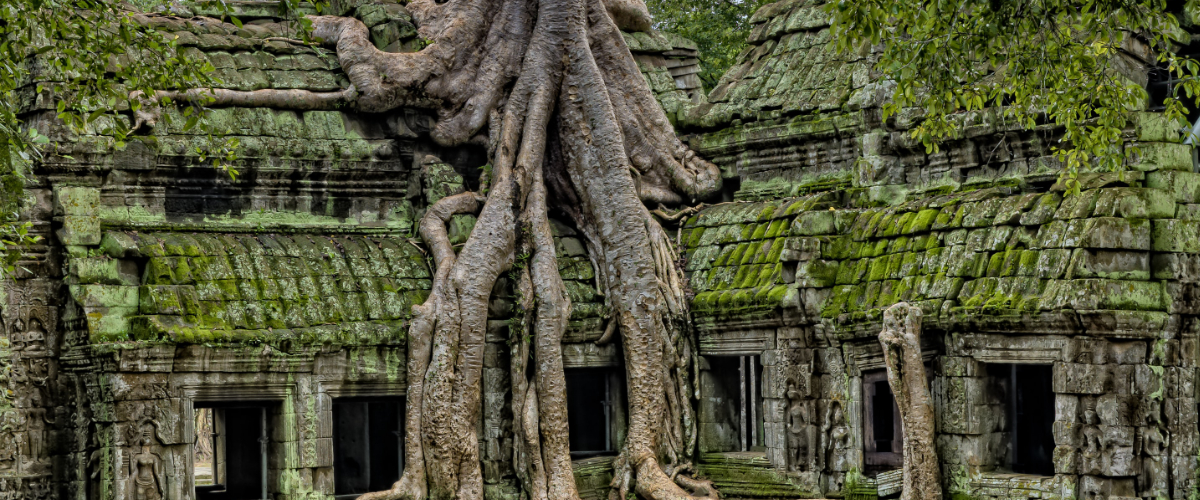
Above: Nature finding its way. Trees slowly taking over the famous Angkor Wat temple in Cambodia.
Therefore, even in a landscape that is designed for minimal intervention; to prevent succession, minor maintenance including the removal of unwanted plants and growth is still a necessity, so to not lose the beauty and function of the finished design.
Why minor maintenance is still required
The abundance of hardy plants that find their way in and are not necessarily wanted are referred to as weeds. It is quite a common misconception that a weed is a specific type of plant, but in fact a weed can be any plant that is not wanted and instead refers to the sole fact it was not intended to be there by design. Aside from affecting the overall look and design of the outdoor space, importantly weeds can also be detrimental to the existing plants, by reducing the natural resources that they should have access to.
It is important in any landscaped garden or space, which is designed to work with nature, to understand why plants are choosing to call it home. All plants that choose to grow somewhere can give us vital information about the soil type and state, the microclimate present, and even prevailing weather patterns to a lesser degree. For example, dandelions are a great indicator that the ground is over compacted. Their roots dig deep and break the competition whilst also bringing up an abundance of minerals helping to support a succession of other plants to grow and flourish. Dandelions are also edible and contain medicinal qualities and for these reasons are an all-around great plant. It is therefore always a shame to see that these are often removed or poisoned with harmful ‘weed’ killers.
Once we have learnt why the weed is there in the first place, we can choose to either remove it entirely or manage and contain the plant to utilise its properties. It is inevitable that over time there will be some plants that will need to be removed to create space for the chosen and planned plants and flora to survive and thrive. It is important to keep the space as a stable environment to maintain ecosystems and to also maintain maximum productivity if opting for a functional edible garden.
The consequences of not undertaking ongoing maintenance
If ongoing minor maintenance is not scheduled following a newly planted landscape design, the space will end up looking vastly different to the initial design as time progresses. Although the plants have been suitability chosen for the environment and planted in the right positioning for sunlight and surface run off, there will always be wild seeds invading that could easily outcompete the new plants. It might seem like you are saving some money by not pursuing with maintenance, but it is worth thinking about how the space will begin to look disorderly.
The level of maintenance required reduces over time
Ongoing minor maintenance is imperative from the start. As the design continues to mature the level of maintenance required will reduce. The initial ‘weeding’ stages allows the perfect opportunity to observe and develop a far greater understanding of the plant relationships with one another.
Have any questions or would like to discuss a landscape design that requires minimal intervention for your outdoor space?
Please head to our Contact page and fill out the online form or alternatively, you can call us directly on 01273 107326 / 07565 842951.